Not All Induction Pans Are Equal
Most people switching to an induction hob already know they need special pans — the hob won't work with just anything. What most people don't know is that in the opinion of FixCookers — based on 30 years of experience as a service engineer — there is a significant difference in quality between induction-compatible pans, and that some types may affect the long-term reliability of your hob.
This guide explains how induction cooking works, what to look for in a pan, and what to avoid.
How Induction Cooking Works
Understanding how an induction hob actually generates heat makes it much easier to understand why the pan base matters so much.
Beneath the glass surface of an induction hob there is a coil of copper wire. When you turn the hob on, an alternating electrical current flows through this coil, creating a constantly changing magnetic field directly above it. The hob surface itself does not get hot — if you put your hand on a zone that is switched on with no pan present, you would feel nothing.
When you place a pan with a ferromagnetic base — one that a magnet will stick to — onto the hob, the changing magnetic field passes into the pan base and induces electrical currents within it, known as eddy currents. These currents cause the molecules in the pan base to vibrate rapidly against each other, and it is this friction that generates heat. The pan heats up almost instantly, and because the heat is generated within the pan itself rather than transferred from a flame or element, induction is highly efficient and precise.
The hob also uses changes in the electrical current to detect whether a compatible pan is present — if no pan is detected, the zone stays off.
Why the Pan Base Matters
For induction to work efficiently, the base of the pan needs to be a solid, consistent ferromagnetic material — typically solid iron or high-grade magnetic stainless steel. When the magnetic field from the hob meets a uniform solid iron base, the eddy currents spread evenly across the entire base and the pan heats consistently from edge to edge.
In the opinion of FixCookers, based on 30 years of experience as a service engineer, the problem arises with a type of pan that has become very common — pans with a base made primarily of iron, with aluminium injected into it in a circular pattern, presumably to reduce the weight of the pan. You can identify these pans by looking at the underside — you will see a distinctive circular or spiral pattern in the base. If you hold a magnet to the base, it will stick to the iron sections but not to the circular pattern sections in between.
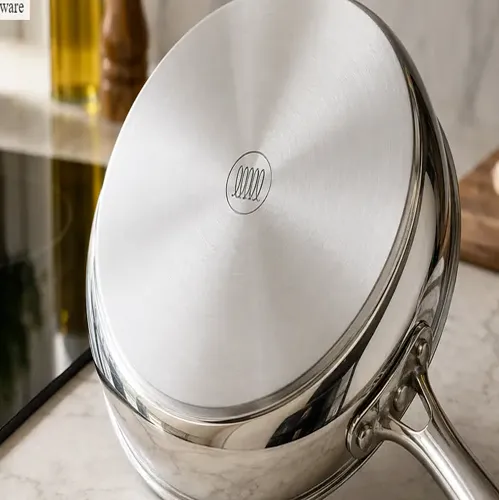
Good — Solid Iron Base
A solid iron or high-grade magnetic stainless steel base. A magnet sticks firmly and evenly across the entire base. The hob heats the pan consistently and efficiently. These are not necessarily more expensive than the alternative.
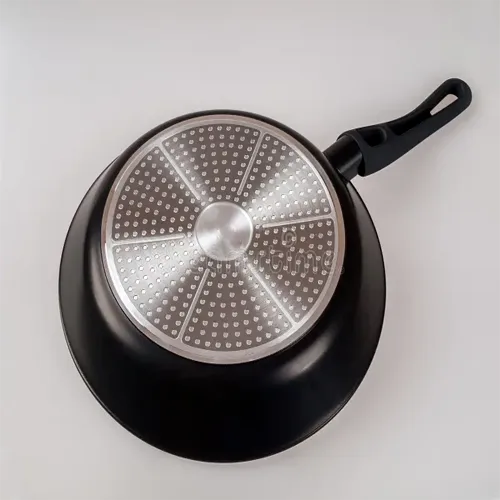
Our Recommendation — Avoid This Type
An iron base with aluminium injected in a circular pattern — presumably to reduce weight. The circular pattern is clearly visible on the underside. A magnet will stick to the iron sections but not to the aluminium sections between them. These pans are widely sold as induction compatible. In our opinion as a service engineer with 30 years experience, they are not the best choice for long-term use on an induction hob.
What Happens When You Use the Wrong Pans
The following is the opinion of FixCookers based on 30 years of experience as a service engineer and is not intended as a statement of fact about any specific pan manufacturer or product.
When the hob's magnetic field meets an inconsistent base — part iron, part aluminium — it cannot induce eddy currents evenly across the whole surface. In our experience, the hob has to work harder to detect and heat the pan, which in our opinion puts additional stress on the induction coil and the electronics beneath the glass.
It is our understanding that research by a major cooker manufacturer found that consistent use of this type of pan can cause induction hobs to fail prematurely. The most common symptoms are error codes on the display and zones on one side of the hob stopping working — though it is worth noting these symptoms can also occur as a normal fault entirely unrelated to pan quality.
In one case personally observed by FixCookers, a customer using this type of pan experienced a cold spot in the centre of their frying pan — suggesting the hob was struggling to heat the aluminium sections of the base consistently. This may occur to a lesser extent with other similar pans without the customer noticing, though we cannot state this with certainty.
The Magnet Test
The simplest way to check any pan — new or existing — is the magnet test. Take a magnet and hold it against the base of the pan.
- Magnet sticks firmly and evenly across the whole base — good pan, suitable for induction
- Magnet sticks in some areas but not others — aluminium-injected base, not recommended for regular use on induction
- Magnet does not stick at all — not induction compatible
Do this test before buying new pans — many retailers will let you bring a magnet in, or simply check if the circular pattern is visible on the underside in the packaging.
Price Is Not a Reliable Guide
It would be easy to assume that more expensive pans are automatically better — but this is not always the case with induction pans. Pans with a solid iron base are not necessarily more expensive than the aluminium-injected alternatives. The magnet test is a far more reliable indicator of quality than the price tag.
When buying induction pans, turn the pan over, look at the base and apply the magnet test. That tells you everything you need to know.
Questions About Your Induction Hob?
If your induction hob is showing error codes or zones have stopped working, FixCookers can diagnose and repair it. Based in South Yorkshire, covering Sheffield, Rotherham and Barnsley.

07951 899378
WhatsApp Us